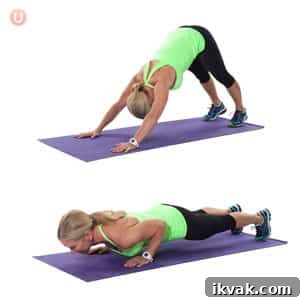
The Downward Dog Push-Up combines the classic yoga Downward Dog with a traditional push-up to create a move that builds upper-body strength while improving flexibility. It targets the chest, shoulders, arms and core and also provides a deep stretch for the back, calves and hamstrings. When performed with good form, this hybrid exercise delivers both functional strength and mobility benefits, making it a useful addition to many workouts.
Before attempting the Downward Dog Push-Up, be sure you have a solid standard push-up. If you can perform 8–10 quality push-ups with proper alignment, you’re ready to incorporate the Downward Dog variation. The Downward Dog on its own is also excellent as a standalone stretch; combined with a push-up, it becomes an efficient way to work strength and flexibility together.
Downward Dog Push Up Exercise Instructions
- Start with hands and feet approximately shoulder-width apart and hips lifted so your body forms an inverted V (Downward Dog).
- From the Downward Dog, shift your weight forward until your hips lower toward a push-up position. When your hips are roughly parallel to the floor, perform a controlled push-up. After completing the push-up, press your hips back up to return to the inverted V position.
If maintaining alignment during the push-up is difficult, you can modify by coming forward from Downward Dog, placing your knees on the floor, and finishing the push-up from a kneeling position. A kneeling push-up is an effective modification that helps you build strength without compromising form. Remember to breathe steadily as you move between positions and keep your core engaged throughout the exercise.
What Muscles Does A Downward Dog Push Up Work?
The Downward Dog Push-Up is an efficient upper-body and core exercise. It primarily engages the chest (pectorals), shoulders (deltoids), triceps and upper back muscles during the push-up portion. The transition and Downward Dog portion recruit the abdominals and lower back to stabilize the torso, while simultaneously stretching the calves, hamstrings and spinal muscles.
Benefits of a Downward Dog Push Up
Incorporating the Downward Dog Push-Up into your routine offers several advantages:
Stronger Upper Body
This movement challenges multiple upper-body muscle groups. Combining a strength-based push-up with the stability demands of the Downward Dog helps sculpt and strengthen the chest, shoulders, biceps and triceps while improving overall upper-body control.
Stronger Core
The transition between poses requires continuous core engagement. Your entire abdominal wall and lower-back stabilizers work to maintain alignment through the shift in body position, making this a valuable core-strengthening exercise.
Stretch and Release
Beyond strength, the Downward Dog portion provides a progressive stretch along the body’s posterior chain—from the heels and calves to the hamstrings and lower back. Repeatedly pressing back into the pose allows for incremental gains in flexibility and muscle release.
How Many Calories Do Downward Dog Push Ups Burn?
Calorie burn varies with intensity, pace and individual factors such as body weight. Exercises performed at moderate to high intensity generally burn around 100 calories per 10 minutes, but slow, strength-focused moves like Downward Dog Push-Ups emphasize muscle development and stability rather than high calorie expenditure. While the immediate calorie burn may be lower than cardio or plyometric exercises, building muscle contributes to greater metabolic efficiency over time.
Other Exercises Similar to Downward Dog Push Up
If you enjoy the Downward Dog Push-Up, try these related movements to vary your training and target similar muscle groups with different challenges:
- How To Do Push Up T
- How To Do Dolphin Dive
- How To Do Tripod