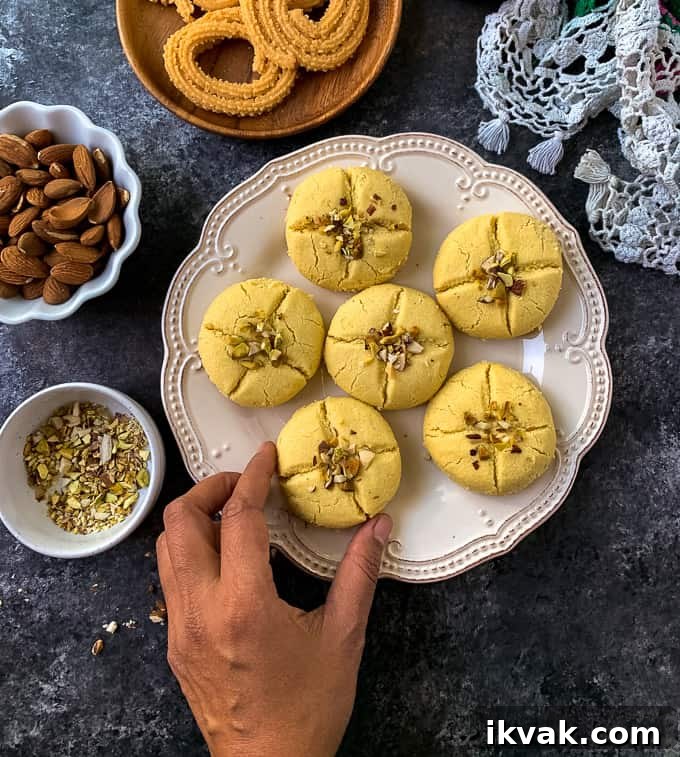
This Nankhatai recipe (Indian butter cookies) yields tender, crumbly cookies that melt in your mouth. Made with five simple ingredients and scented with cardamom and a hint of nutmeg, these biscuits are mildly sweet and pair perfectly with tea or coffee.
With Diwali approaching, the festival of lights and flavors, I’m excited to bake and fry a variety of Indian snacks like these Nankhatai, Shakarparas, crispy chakli, thandai fudge and more. These treats make lovely gifts for family and friends—what will you be making this Diwali?
Nankhatai gets its name from Persian: “Naan” meaning bread and “Khatai” (from Dari Persian) meaning biscuit. Often called Indian shortbread, it’s a traditional eggless cookie that typically requires no baking powder or baking soda.
Best Eggless Indian Cookies
These Nankhatai are easy to make at home using pantry staples. With just a few common ingredients—flour, ghee, sugar and spices—you can quickly prepare these delicious eggless cookies suitable for kids and guests alike.
No special baking skills or tools required
No specialized equipment is needed—just a spoon to mix. This recipe is ideal for beginners; even if you’ve never baked before, you can confidently make these nankhatai.
My affection for these cookies goes back decades. They were the first cookies I tasted as a toddler, when store-bought baby food wasn’t common and most snacks were homemade. My mother made a healthier version for me using ragi, whole wheat flour, ground almonds, ghee and jaggery. Back then ovens were uncommon, and my mother and aunts used to bake these in a pressure cooker.
Over the years I’ve enjoyed many versions. The choices of flours and fats vary from household to household, giving each nankhatai its own character.
Different styles of making Nankhatai
- Some families use only maida (all-purpose flour) and semolina (rawa).
- Others combine maida and besan (chickpea flour) without semolina.
- Many recipes include yogurt or sweetened condensed milk.
- My aunt makes a blend of maida or atta (whole wheat flour) with besan and semolina.
Besan adds an earthy note while semolina contributes the characteristic grainy texture. I find this combination ideal for cookies that are both crisp and melt-in-the-mouth. As my grandmother used to say, “Nankhatai bilkul khasta honi chahiye jo muh mein ghul jaye.”
Today I’m sharing a tested butter-cookie style nankhatai recipe using maida or whole wheat flour, sugar and ghee. It’s simple, requires no leavening agents or yogurt, and uses minimal ingredients.
Ingredients for making Nankhatai
These classic Indian biscuits are made with a handful of staples—flour, ghee (clarified butter), sugar and warm spices like cardamom. Some people use butter instead of ghee. Nankhatai are similar to buttery sugar cookies, but they’re egg-free and do not use baking powder or baking soda.
Flavorings such as cardamom, nutmeg or saffron are optional but recommended for depth of flavor. Traditionally, nankhatai are marked with a thumb indentation or criss-cross lines and topped with chopped nuts.
Step-by-step overview
- Cream room-temperature ghee with icing sugar using a spoon until smooth.
- Add all flours, cardamom, nutmeg and salt.
- Mix initially with a spoon, then use your fingers to bring the dough together.
- Knead until smooth. Rest the dough, covered, for 15–20 minutes in the fridge.
- Divide into equal balls, flatten slightly, make criss-cross lines or a thumbprint, and top with chopped nuts if desired.
- Bake in a preheated oven at 180°C (350°F): 17–19 minutes for large cookies, 10–12 minutes for smaller ones.
- Allow cookies to cool on the tray for 10–15 minutes before transferring to a rack. Cool completely before storing.
Tips for the best Nankhatai
- Use ghee at room temperature—semi-solid, not fully melted.
- Use powdered (confectioners) sugar, not granulated sugar, for a tender texture.
- Rest the dough in the fridge for 15–20 minutes to help the cookies retain their shape.
- After baking, let cookies cool on the tray for 10–15 minutes; they firm up as they cool.
FAQ
How to store Nankhatai cookies?
Store in an airtight container in a cool, dry place for up to three weeks. They rarely last that long!
How to make vegan Nankhatai?
Replace ghee with vegan butter, vegetable shortening or nut butter (almond or peanut). Use organic confectioners’ sugar or powdered coconut sugar if desired.
How to make healthy cookies for babies/toddlers?
Adapt the recipe by using whole grain flours, ragi, jaggery or a reduced sugar amount to create a healthier homemade snack.
How to make Nankhatai without an oven?
You can make nankhatai in a pressure cooker or heavy-bottomed kadai on the stovetop, or use the convection mode in a microwave if available.
My Diwali party menu will include:
Welcome Drink
Chatpata Healthy Mojito or Watermelon Gazpacho (choices)
Appetizers / Starters
Veg Hariyali Kebabs and Gujiya-style Kachoris
Main Course
Badami Paneer Curry, Kale Saag with Chickpea Tofu and Saufiyana Shimla Mirch
Dessert
Triple Chocolate Kalakand or Saffron Rice Kheer
Return Gifts
Nankhatai cookies packaged as return gifts.
With limited time I’ll use some ready-made frozen naan and parathas. Tell me in the comments what you plan to make for your Diwali party or potluck.
Are we friends yet? Let’s connect on social media.
Don’t forget to subscribe for recipe updates and save this recipe for later. If you try it, please leave a star rating and comment below.
How to make Easy Nankhatai at home
US standard measuring cup used. 1 cup = 240 ml
Nankhatai Recipe (Indian Butter Cookies)
Ingredients
- ½ cup / 113 ml ghee at room temperature not melted
- ½ cup 60 grams confectioners sugar / icing sugar
- 1 cup / 138 grams maida or wheat flour
- ½ cup / 52 grams besan (chickpea flour)
- ¼ cup / 45 grams rawa (semolina)
- ½ teaspoon cardamom (elaichi) powder
- ¼ teaspoon freshly grated nutmeg (optional)
- ¼ teaspoon salt
Toppings
- Chopped almonds
- Chopped pistachios
Instructions
-
Whisk room-temperature ghee and confectioners sugar with a spoon until creamy.
-
Add all flours, cardamom, nutmeg and salt.
-
Mix with a spoon, then use your fingers and palms to rub the mixture together until it forms a cohesive dough.
-
Knead briefly until the dough is smooth. Rest covered in the fridge for 15–20 minutes.
-
Preheat the oven to 350°F (180°C).
-
Divide the dough into equal balls (9 for large cookies or 16 for small). Flatten slightly; these cookies don’t spread much.
-
Make criss-cross lines or a thumbprint in each cookie and press chopped nuts in the center if desired.
-
Bake: 17–19 minutes for large cookies, 10–12 minutes for small ones, until dry to touch and slightly browned at the base.
-
Cool on the baking tray for 10–15 minutes, then transfer gently with a spatula. Allow to cool completely before storing.
Notes
- The warmth of your palms is usually enough to bring the dough together; avoid adding extra liquid unless necessary.
- If the dough remains crumbly after kneading, add ghee 1 teaspoon at a time until it binds.
- You can substitute besan with the same amount of maida or atta if preferred.
- Using confectioners sugar (with a bit of cornstarch) helps make nankhatai lighter and more tender.
- Greasing the baking tray is optional.
- Toppings are optional—use a single almond, chopped nuts or sprinkles as you like.
- Add a pinch of saffron for a fragrant variation.
How to know the cookies are done?
Oven temperatures vary. Smaller cookies usually take about 12 minutes, larger ones around 18 minutes.
Cookies are ready when they feel dry to the touch, are no longer doughy and have a slight brown at the base. They will be soft when removed but firm up as they cool—do not overbake.
How to store Nankhatai?
Keep in an airtight container in a cool, dry place for up to three weeks.
Expert tips
• Use semi-solid room-temperature ghee rather than fully melted ghee.
• Use powdered sugar for a delicate crumb.
• Chill the dough briefly to help the cookies hold their shape.
• Cool cookies on the tray for 10–15 minutes before transferring to avoid breakage.
Nutrition
Carbohydrates: 20 g |
Protein: 4 g |
Fat: 10 g
Happy cooking! If you make this recipe, please share a photo and tag the creator to be featured. Thank you for stopping by!
IF SHARING, PLEASE LINK BACK TO THE POST. REPRODUCING, DISTRIBUTING OR COPYING PICTURES OR TEXT/RECIPES THAT BELONG TO CARVE YOUR CRAVING IS A COPYRIGHT VIOLATION.